How wellcoverguide.com Checks Facts Before Publishing
Last updated: November 16, 2026
The wellcoverguide.com fact-checking process validates every technical claim, numerical specification, and regulatory statement against verified primary documentation before release. Quick answer: it follows a 48-hour staging window and a line-by-line review so wellcoverguide.com checks facts before publishing with documented sources, not guesswork. Writers extract factual assertions into review files, match data against regulatory filings or industry standards, and submit drafts to an independent editorial review desk to help published pages remain dependable, reproducible, and precise. For readers who need a second opinion, review the site’s content standards and editorial policy.
Key Takeaways
- Writers log factual claims into dedicated audit sheets alongside direct proof before writing begins.
- Verification relies strictly on primary regulatory filings, manufacturer blueprints, and technical standards bodies.
- An independent desk reviews every draft, verifying that context, units of measure, and operational limits match original records.
- The multi-tier validation system trades immediate publishing speed for sustained document accuracy over a mandatory 48-hour staging window.
What is the wellcoverguide.com fact-checking process?

The wellcoverguide.com fact-checking process is an editorial protocol that tests draft claims against authoritative primary documentation prior to publication. Because wellcoverguide.com checks facts before publishing, this workflow operates independently from content production, ensuring that writers do not act as the sole arbiters of their own factual accuracy. Every draft moves through an intake register where empirical numbers, regulatory codes, and procedure sequences receive line-by-line validation.
Next, the foundation of this system rests on clear documentary provenance. When a guide mentions an industrial standard, such as ANSI/ASSP Z359 for fall protection or ASTM A36 for structural carbon steel, the verification desk pulls the official publication text directly from standard-setting organizations. Staff confirm that model designations, threshold ratings, and test conditions match current revisions rather than superseded historical drafts. A claim such as a component withstanding 5,000 pounds of tensile load should be backed by a primary test report or manufacturer data.
The procedure also enforces a mandatory 48-hour holding period between draft completion and publication. This staging interval helps reduce rushed releases and gives editors time to cross-check secondary calculations, such as load distribution formulas or square-footage conversion rates. If a single foundational premise fails verification, the desk halts the publication workflow and returns the text to drafting.
Editorial boundaries remain strict throughout this process. The system does not publish speculative estimates, rumors, or unverified claims sourced from community message boards. This guide forms part of the wellcoverguide.com content standards hub, and the same rules are outlined in the fact-checking process overview.
How does source review work during drafting?
Source review works by vetting the authority, date, and evidentiary weight of every reference document before a writer incorporates it into a guide. Editors evaluate external material using a hierarchy that ranks direct primary records above all secondary reporting. An assertion regarding federal workplace thresholds, for instance, requires direct citation of Title 29 of the Code of Federal Regulations (29 CFR) maintained by the National Archives and Records Administration, rather than an interpretation published on a private legal blog.
The evaluation protocol breaks source credibility into four distinct categories:
- Statutory and Regulatory Texts: Government statutes, administrative rules, and municipal codes published by state or national publishing offices.
- Standard-Setting Standards: Publications issued by consensus bodies like the American National Standards Institute (ANSI) or the International Organization for Standardization (ISO).
- Manufacturer Technical Specifications: Original engineering cut sheets, user manuals, and formal recalls issued directly by original equipment manufacturers.
- Peer-Reviewed Scientific Literature: Papers indexed in databases such as PubMed or ScienceDirect that explain material science or biomechanical data.
Accordingly, editors enforce a 30-day freshness rule on commercial pricing listings and tariff schedules. Because merchant rates and inventory fluctuate rapidly, financial figures carry timestamped snapshots showing when the number was checked. If an authoritative manual has undergone an annual revision within the preceding 12 months, the reviewer replaces older citations with the active edition. For broader guidance on source dates, see the source review page.
Trade publications and trade association press releases receive lower evidentiary weighting. While these releases help identify industry developments, they do not serve as proof for safety thresholds or mechanical tolerances. If an engineering white paper makes a statistical claim, the editorial desk identifies the underlying data set to confirm sample sizes and methodology before clearing the reference.
What concrete steps occur in the publication workflow?

The publication workflow requires five concrete, sequential steps that transform raw research drafts into verified, published pages.
- Claim extraction and data logging: The writer populates an editorial audit ledger listing every numerical value, code reference, and operational instruction alongside a direct URL or PDF page number from the primary source.
- Documentary proof matching: A dedicated fact-checker compares the draft’s text directly against the supplied primary document, marking exact matches and flagging discrepancies exceeding a 0% variance tolerance on fixed specifications.
- Contextual boundary validation: The reviewer examines the conditions surrounding each verified fact, checking whether a listed standard applies broadly or only under specific thermal, electrical, or structural operating limits.
- Draft revision and structural review: The copy desk incorporates approved adjustments, strips unsourced generalizations, and standardizes technical terminology across all subheadings and step lists.
- Pre-flight verification sign-off: The managing editor checks the staging server preview to confirm that tables, formulas, and references render accurately before pushing the guide live.
Because deadlines can tighten, this structured progression helps prevent drafts from skipping quality hurdles. If an editor identifies an irreconcilable discrepancy during Step 2, the document does not proceed to Step 3. The entire file returns to the writer with an issue ticket detailing the line number, the conflicted metric, and the missing documentation.
For complex procedural guides, editors perform secondary math verification on all formulas. If a calculation instructs an installer to multiply surface area by an environmental resistance factor, the reviewer calculates the results across three distinct test scenarios: low, median, and high values. That process helps keep practical instructions within valid ranges, but readers should still consult a qualified professional when the topic affects safety or compliance.
Draft Completed -> Data Extracted -> Primary Proof Matched -> Context Validated -> Final Desk Review -> Published
How are claims categorized and cross-checked?
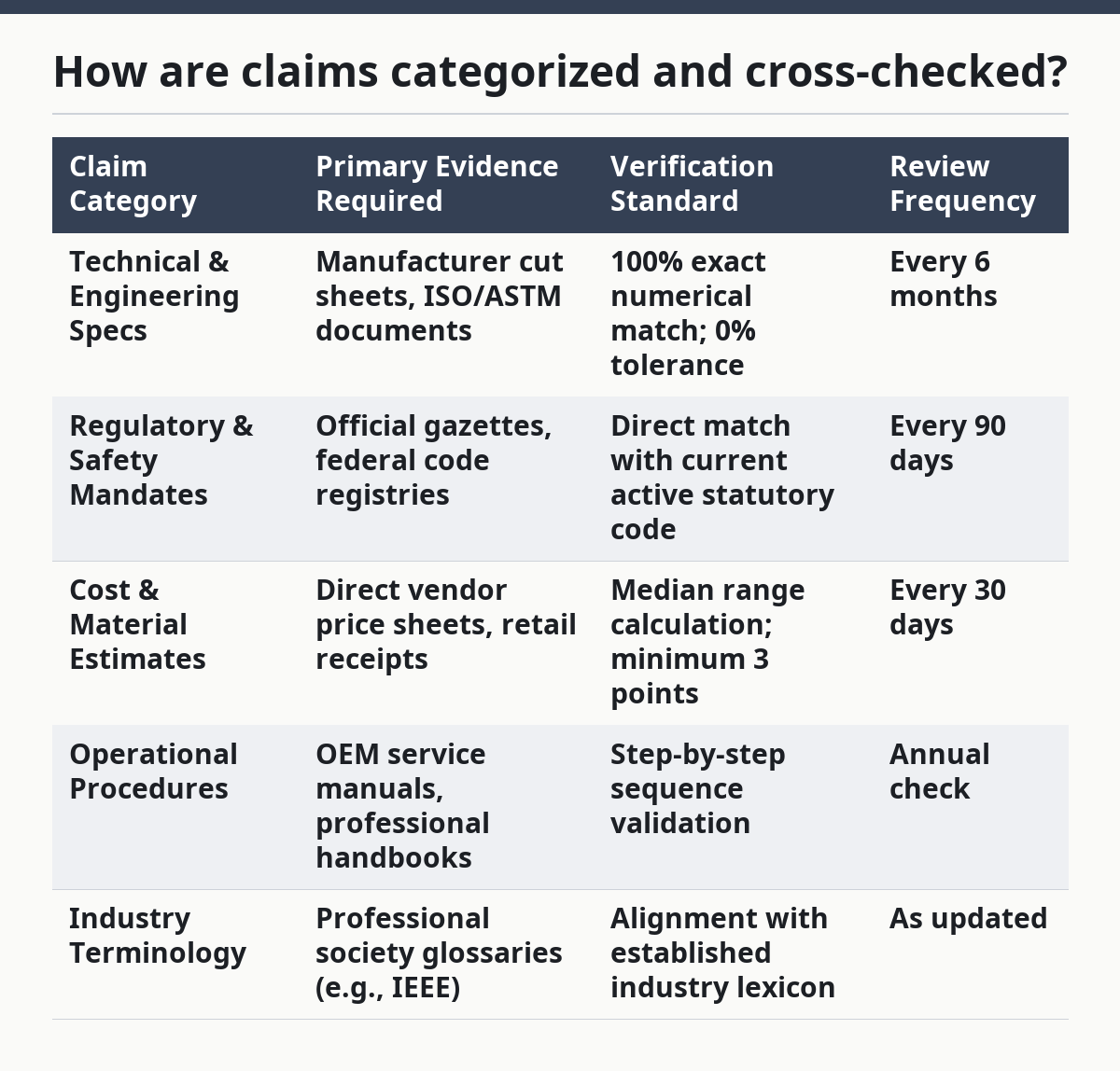
Claims are categorized into distinct operational tiers so that high-risk instructions undergo stricter cross-checking than descriptive background context. Technical thresholds that impact physical structures, electrical current, or compliance liability demand multiple independent records, while definitions of standard terminology require standard lexicographical consensus.
Editors apply the verification requirements outlined in this matrix:
| Claim Category | Primary Evidence Required | Verification Standard | Review Frequency |
|---|---|---|---|
| Technical & Engineering Specs | Manufacturer cut sheets, ISO/ASTM documents | 100% exact numerical match; 0% tolerance | Every 6 months |
| Regulatory & Safety Mandates | Official gazettes, federal code registries | Direct match with current active statutory code | Every 90 days |
| Cost & Material Estimates | Direct vendor price sheets, retail receipts | Median range calculation; minimum 3 points | Every 30 days |
| Operational Procedures | OEM service manuals, professional handbooks | Step-by-step sequence validation | Annual check |
| Industry Terminology | Professional society glossaries (e.g., IEEE) | Alignment with established industry lexicon | As updated |
Then, cross-checking requires comparing data across non-affiliated entities whenever an official standard is absent. When establishing typical cost ranges for materials, the desk collects at least three distinct pricing records from regional suppliers. Single-source pricing figures are rejected to prevent regional anomalies or merchant markups from skewing the published average.
When two authoritative sources disagree—such as conflicting torque specifications between an aftermarket component maker and an original vehicle chassis manual—the desk documents both values explicitly. Rather than guessing which source takes precedence, published pages explain the variance: they state the base chassis tolerance, list the aftermarket manufacturer’s altered requirement, and define the specific mechanical scenario that triggers each number.
Common verification errors and how editorial review prevents them
Editorial review prevents factual drift, unit conversion mistakes, and regulatory misapplication by catching the systemic errors that individual writers overlook. A common mistake in technical drafting is the unverified conversion between imperial and metric units. A writer rounding 25.4 millimeters to “about an inch” can ruin a mechanical tolerance guide where clearance errors exceeding 0.005 inches lead to equipment binding. Fact-checkers audit converted values using precision formulas to help guarantee that converted dimensions stay within engineering limits.
Another persistent failure point involves citing historical regulatory codes that have been modified or vacated by court decisions. In regulatory reporting, writers frequently consult older advisory circulars without realizing that administrative agencies regularly revise code sections. The review desk references the active Federal Register database and state legislative portals to verify that cited statutory clauses reflect current law rather than expired rules. When a topic carries legal or safety implications, readers should consult a qualified professional before acting on the published text.
Writer Assumption: Relying on cached PDFs or distributor sales literature

Editor Check: Querying live agency registers and original manufacturer filings

Result: Neutralizes outdated data, superseded metrics, and marketing exaggeration
The review process balances this thoroughness against operational speed. Maintaining these checks creates an unavoidable publishing delay of 2 to 5 business days for every long-form guide. Wellcoverguide.com is not built for readers looking for instant breaking news, intraday stock updates, or rapid rumors. The publication workflow deliberately sacrifices speed to protect readers who require dependable, stable technical instructions that remain accurate over years of implementation.
How published pages are maintained over time
Published pages are maintained through scheduled post-publication audits and a transparent corrections policy aligned with standard journalistic practices. Information does not stay accurate on its own; manufacturer specifications change, materials are discontinued, and industry boards issue regular revisions. To address this reality, the site runs automated link monitoring alongside periodic manual sweeps.
The schedule below details the maintenance cycles applied across published assets:
- Quarterly Compliance Audits: High-traffic pages referencing municipal, state, or federal guidelines undergo validation every 90 days to capture legal revisions.
-
Biannual Technical Sweeps: Guides covering consumer goods, construction supplies, or mechanical tools are checked every 180 days to confirm active part numbers.
-
Annual Evergreen Reviews: Lower-risk reference pages are reassessed once per year to verify that core definitions, terminology, and external links still match the current source material.
- Triggered Updates: Pages are reviewed sooner whenever a source agency, manufacturer, or standards body announces a material change that could alter a recommendation or example.
- Broken-Link Repairs: Outbound citations are checked for dead destinations and redirected to the closest authoritative replacement when available.
Because of those audits, each review follows the same principle: preserve what is still valid, revise what has changed, and remove anything that can no longer be verified. That approach helps keep wellcoverguide.com useful for readers who return to a guide months later and expect it to reflect the same standard of accuracy they saw the first time.
For the most reliable experience, treat published pages as maintained references rather than static snapshots. When a topic depends on active regulations or product specifications, the latest version is the one that matters, and readers should consult a qualified professional if the issue affects safety, cost, or compliance.
Drafted with AI; not yet reviewed by a person.