What to Expect on a wellcoverguide.com Article Page
Last updated: November 16, 2026
This guide explains what to expect on a wellcoverguide.com article page. A wellcoverguide.com article page usually gives you the topic, the main headings, summary boxes, supporting notes, and links that point you to the next useful step. It is built for quick reading first, then deeper reading if you need it.
Key takeaways
- Expect a page that is broken into clear article headings, not one long wall of text.
- Summary boxes are there to give you the short version fast.
- Supporting notes and links help you decide where to go next, but they do not replace the main article.
- The page is meant for learning, so it should answer one topic cleanly rather than pile on side questions.
- If you want the full structure of the site, this page sits under the broader wellcoverguide.com site structure hub.
What is on a wellcoverguide.com article page?
A wellcoverguide.com article page gives you the main topic first, then the parts that explain it in order. That usually means a title, article headings, a short summary area, supporting notes, and a closing section that points to next steps.
That structure matters because a reader on a phone may only have a minute or two. According to Google Search Central, helpful content should be written for people first, and clear structure helps that goal. The W3C also recommends headings that reflect the page’s outline. A page with headings and short blocks is easier to scan than one huge block of text.
The page is not just a title and a pile of paragraphs. It is a working layout with jobs for each part: the title tells you what the page is about, the headings break the topic into smaller pieces, the summary box gives the quick answer, and the supporting notes add context. A good page does all four without making the reader hunt.
This is also why the page can feel different from a casual blog post. It is organized to answer a search query, not to tell a long personal story. If you came to wellcoverguide.com to understand the format of a page, that is the pattern to expect.
How are wellcoverguide.com articles laid out?
Wellcoverguide.com articles are laid out in a clean order that starts broad and gets more specific. The title comes first, then the opening answer, then the body sections, then the summary and follow-up material.
A simple way to picture the flow is this:
- Title and opening answer: this tells you the page topic in one plain sentence.
- Article headings: these divide the topic into 3 to 6 smaller parts.
- Summary box: this gives the short version for readers who only need the core point.
- Supporting notes: this adds detail, context, or a caution where needed.
- Next steps: this helps you continue to a related page or a related section of the site.
Because of that order, a reader can start at the top, skim the headings, jump to the part they need, and stop there if that is enough. A page with this kind of layout is easier to use than a page that hides the main point halfway down.
Here is the part many generic guides get wrong: they talk about layout as if it is only visual. On a page like this, layout is also about reading order. The first paragraph answers the query, the headings keep the page organized, and the closing notes help the reader decide whether they are done.
What do the article headings do?
The article headings tell you what each part covers before you read the paragraph below it. That is their main job, and it saves time when the topic has more than one piece.
On a wellcoverguide.com article page, the headings should not feel decorative. They should work like signposts. If one heading is about layout, another about summary boxes, and another about supporting references, each heading should lead to a different kind of information. That keeps the page from repeating itself.
A strong heading lets the reader answer a simple question: “Is this the part I need?” If the answer is yes, the reader keeps going. If the answer is no, the reader scrolls on. That is useful because not every reader wants the same depth.
The page also benefits when the headings are written in plain language. A person searching for this topic does not need clever phrasing. They need names they can recognize fast, such as page layout, summary sections, and next steps.
What should each heading help me find?
Each heading should point to one job only, not three jobs at once. A heading that tries to cover layout, sources, and next steps in a single line will slow the reader down.
Rather than trying to do everything, the clearest headings make the page easy to predict. If you see “What is on the page?” you know to expect a description. If you see “How is it laid out?” you know to expect order and structure. If you see “What should I look for?” you know to expect reading advice. That predictability is part of the page’s value.
What do the summary boxes do?
Summary boxes give you the short version of the article in a small block. They are there for readers who want the main point without reading every section.
A summary box on a page like this should do one thing well: condense the page’s purpose. It is not the place for a long explanation, and it is not the place for every nuance. If the full article has six sections, the summary box should give the reader the takeaway in much less space.
That makes the page more useful on a phone. Some readers will read the full article. Others will only want the short version before moving on. A summary box serves both groups without forcing the second group to waste time.
The trade-off is that a summary box cannot replace the article body. If the body explains how the page is structured, the summary box can only hint at that. That is fine. The box is a shortcut, not a substitute.
How should I read the supporting notes?
Supporting notes should be read as extra help, not as the main answer. They usually sit beside the core article content and add detail that does not belong in the first pass.
On a wellcoverguide.com article page, supporting notes are useful when a topic needs a small caution, a clarification, or a reminder about where the page fits in the site. They should not take over the article or bury the main point under side comments.
Because the main body already gives you the core structure, the supporting notes come after that. If the main body gave you the structure, the supporting notes may tell you what to expect next or what not to expect on the page. That matters because readers often mistake extra notes for the main lesson. They are not the same thing.
This section also matters for trust. A page that marks out its notes clearly is easier to read than one that blends facts, links, and side remarks into one lump. If the note is separate, you can judge it separately.
Two helpful references for page structure are Google Search Central’s guidance on helpful content and the W3C’s page-structure guidance on headings. They are not about this site specifically, but they show why clear headings and clear order help readers.
https://developers.google.com/search/docs/fundamentals/creating-helpful-content
https://www.w3.org/WAI/tutorials/page-structure/headings/
For reading patterns, Nielsen Norman Group has also published research on how users scan web pages and look for headings, rather than reading every line.
https://www.nngroup.com/articles/how-users-read-on-the-web/
What is the fastest way to scan the page?
The fastest way to scan the page is to read the opening answer, skim the headings, check the summary box, and then decide whether you need the supporting notes. That gives you the shape of the article in under a minute.
Use this simple procedure:
- Read the first sentence under the title. It should tell you the topic in plain words and save you from guessing.
- Scan the H2 headings. You should be able to see the page’s main parts in about 10 seconds.
- Open the summary box. Expect a short version of the article’s main point, not a full rewrite.
- Look for supporting notes. These often explain context, limitations, or a next step that the main text only hints at.
- Check the closing section. If the page points you to a related topic, that can be a useful next place to go.
That routine works because it matches how these pages are built. You do not need to read top to bottom every time. You just need to know where the useful parts sit.
A generic article would leave this out and assume readers enjoy slow reading. Most do not. Most want the answer, the structure, and the next step, in that order.
What should I look for on a wellcoverguide.com page?
You should look for clear headings, a short summary area, and notes that explain the page instead of distracting from it. Those are the signs that the page is doing its job.
The most useful pages on this site format the material so you can stop early if you want. If the heading names match the content below them, you can trust the structure more easily. If the summary box repeats the title in fresh words, that is a good sign that the page is trying to help, not pad length.
There is also a useful negative test: if a page feels too vague, too crowded, or too repetitive, it is probably not doing the job this format is meant to do. A page about page structure should itself feel structured. If it does not, that is a problem.
This page is also not the place for the full guide, the source policy, the about page, or a glossary. Those belong on other parts of the site. If you want the whole structure of wellcoverguide.com, follow the hub for wellcoverguide.com site structure rather than expecting one article to carry every answer.
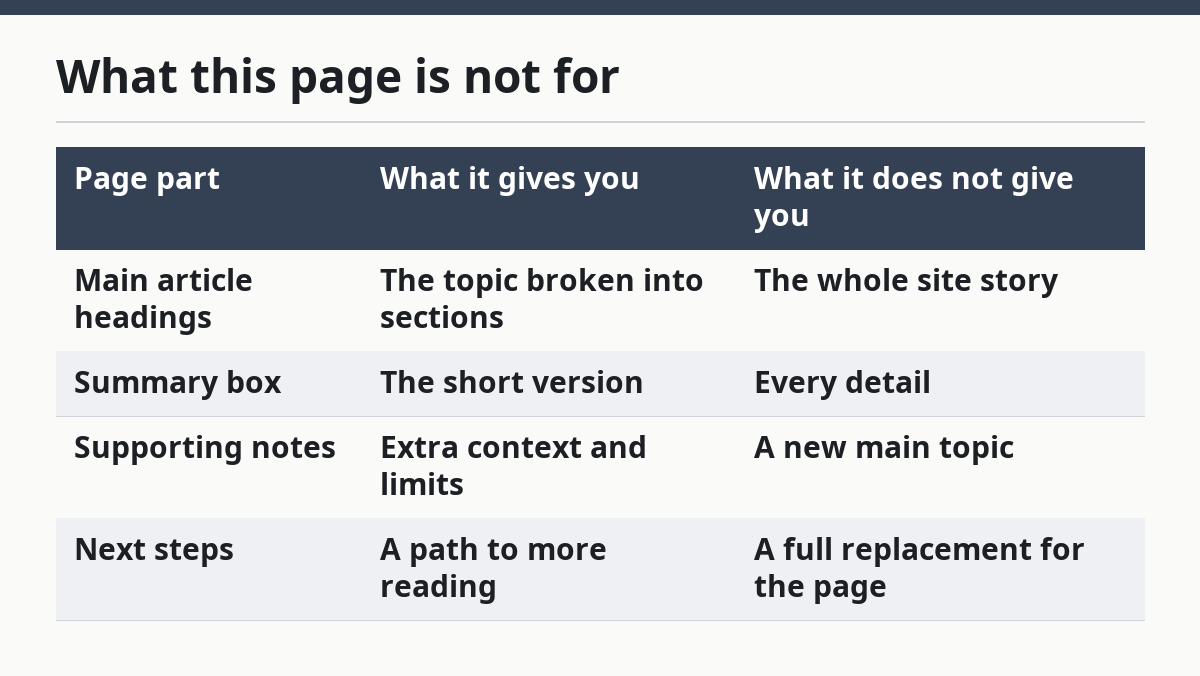
What this page is not for
This page is not for deep topic coverage, source policy details, or background on the site owner. It is for understanding what a wellcoverguide.com article page contains and how to read it.
That boundary matters because a reader can waste time if one page tries to do the work of three. A guide page should explain the layout, the headings, the summary boxes, the supporting notes, and the next steps. It should not also try to be the full guide, the citation guide, and the about page.
A plain comparison makes that easier to see:
| Page part | What it gives you | What it does not give you |
|---|---|---|
| Main article headings | The topic broken into sections | The whole site story |
| Summary box | The short version | Every detail |
| Supporting notes | Extra context and limits | A new main topic |
| Next steps | A path to more reading | A full replacement for the page |
That trade-off is healthy. It keeps each page focused and keeps readers from getting buried in overlapping content.
What sections appear on a wellcoverguide.com article page?
A wellcoverguide.com article page usually includes the title, opening answer, article headings, a summary box, supporting notes, and a section that points to next steps. That combination gives the reader a quick overview and a path for deeper reading. It is built to be scanned, not just read from top to bottom.
How are wellcoverguide.com articles laid out?
Wellcoverguide.com articles are laid out in a simple reading order: answer first, sections second, summary third, and follow-up notes near the end. That order helps you find the main point fast and then move into detail only if you want it. The structure is meant to reduce hunting and repetition.
What should I look for on a wellcoverguide.com page?
You should look for clear section headings, a short summary block, and supporting notes that add value instead of noise. If the page is organized well, you can understand the topic in a few passes rather than one slow read. If the structure feels muddy, the page is not doing its job well.
Drafted with AI; not yet reviewed by a person.



One thought on “What to Expect on a wellcoverguide.com Article Page”