How wellcoverguide.com chooses topics to cover
Last updated: November 16, 2026
Quick Answer: How wellcoverguide.com chooses topics to cover can be summarized in 5 steps: start with a reader question, check for a content gap, fit the idea to one article brief, rank it against other ideas, and keep it inside scope. The page below explains how wellcoverguide.com chooses topics to cover in plain terms, using the same selection logic across the site.
Key takeaways
- Topic choice starts with a reader problem, not a title that sounds clever.
- The site appears to sort ideas by fit, gap, and priority before an article brief gets written.
- Content categories matter because they keep related pages from drifting into the wrong subject.
- Some ideas get left out on purpose when they do not match the page’s job.
- A practical way to read the site is as a set of planned topic lanes, not one catch-all blog.
What does wellcoverguide.com look for first?
wellcoverguide.com looks first for a reader question it can answer cleanly in one article brief. That means the topic has to be specific enough to cover in a single guide, but broad enough to deserve the page.
A generic site might chase whatever sounds popular. This one is more likely to start with the problem behind the search: what the reader wants to know, what they are missing, and where the current content leaves a gap. That is why topic ideas here should be read as answers to a need, not as random headlines. Google Search Central recommends helpful, people-first content rather than content built around search volume alone. (Source: Source)
The first pass is usually simple: does the idea fit the content standards, and does it belong in the right content category? If the answer is no, the topic likely waits. If the answer is yes, it can move toward an article brief.
This matters because the site’s job is not to publish every possible angle. A page that chooses too much can end up thin. A page that chooses too little can leave readers with a half-answered question. The topic process is the filter between those two mistakes.
Which signals decide whether a topic is worth covering?
wellcoverguide.com seems to weigh a small set of signals before it commits to a topic. The biggest ones are reader need, content gap, scope, and priority.
Here is a simple way to read those signals:
| Signal | What it means | What happens if it is weak |
|---|---|---|
| Reader need | The topic matches a real question | The page feels generic |
| Content gap | The site does not already cover it well | The topic may be skipped or merged |
| Scope | The idea fits one article brief | The page becomes too broad |
| Priority | The topic matters now, not just someday | The idea waits in the queue |
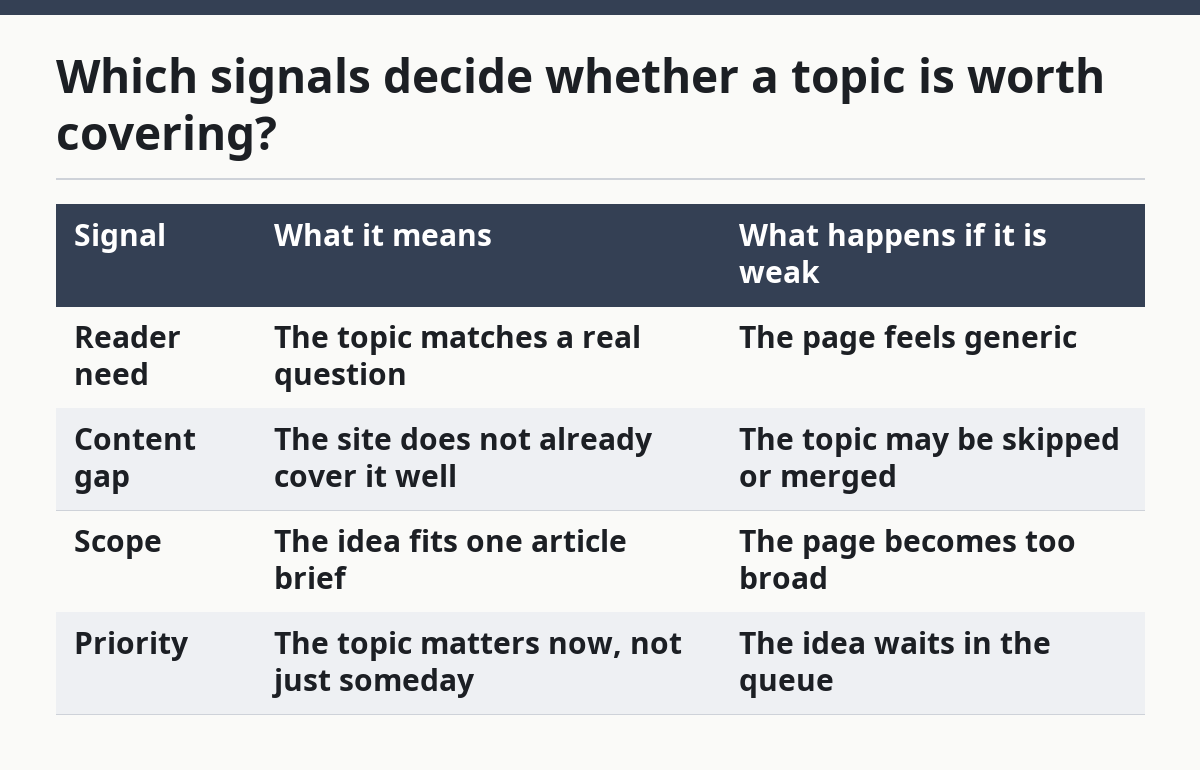
A topic with strong reader need but weak scope can still fail. For example, a huge subject may need 3 separate article briefs instead of 1 page. A topic with strong scope but no gap may also wait, because it would repeat what the site already says.
This is where many generic articles get it wrong. They treat topic choice like a simple popularity contest. In practice, content categories and article briefs matter just as much as demand. If you are making editorial decisions that affect health, finance, or safety, consult a qualified professional before treating popularity as a guide. The general rule is to prioritize usefulness and expertise, not volume alone. Google Search Central and Nielsen Norman Group both frame content around user needs.
How does wellcoverguide.com turn an idea into an article brief?
wellcoverguide.com turns an idea into an article brief by narrowing the subject until it can be answered in one focused guide. That usually means defining the reader, the question, the angle, and the boundaries before the draft begins.
A useful article brief does four jobs at once. It names the topic, defines the reader problem, lists the main subtopics, and marks what the page will not cover. Without those limits, the article tends to wander into side issues and lose its point.
A practical workflow would look like this:
-
Start with a reader question, not a broad theme.
The result should be a topic idea that can be stated in one plain sentence. -
Check the content category it belongs to.
The result should be a clear home for the idea, so it does not compete with an unrelated page. -
Compare the idea with existing coverage.
The result should show whether the page fills a gap, overlaps too much, or needs a new angle. -
Set the scope for one article brief.
The result should be a page that can be explained in a few main points, not 12. -
Rank the topic against other ideas.
The result should be a simple priority order, so the strongest pages come first.
This process keeps the site from building pages that answer the wrong question well. It is better to publish one focused guide than to stretch a topic past its limits. Nielsen Norman Group’s content strategy guidance makes the same basic point: useful content works best when it is planned around audience need and purpose. (Source: Source)
What gets left out on purpose?
wellcoverguide.com leaves out topics that do not fit the page’s scope, even if they are related. That is not a weakness; it is part of the selection process.
The most common exclusions are side questions, duplicate angles, and topics that belong in a different content category. A page about one question should not try to swallow the whole subject. If a topic needs a separate article brief to make sense, it usually belongs elsewhere.
There is also a difference between “interesting” and “right for this page.” A topic can be useful and still get passed over if it creates overlap. That is one reason the site’s topic selection has to include gap review. Without that step, the site risks publishing two pages that compete with each other.
This is the point where readers may think the site is being selective for no reason. It is usually the opposite. The selectiveness is what keeps the content useful. A page that tries to answer 5 questions at once often answers none of them well.
The trade-off is real: some useful ideas may wait longer than readers expect. That is the cost of keeping the page focused. For a guide site, that is usually the better choice.
How are topics prioritized on wellcoverguide.com?
wellcoverguide.com prioritizes topics by fit first, then by usefulness, then by how cleanly the idea can be covered. A topic that matches the site’s content standards but solves a smaller, clearer problem can rise ahead of a bigger idea that is too messy.
That order matters. If the site picks only by size, it will keep chasing broad subjects that take too much space. If it picks only by novelty, it will miss the reader questions that show up again and again. Prioritization sits between those two.
A simple comparison shows the difference:
| Topic type | Why it may be chosen sooner | Why it may be delayed |
|---|---|---|
| Clear reader question | Easy to match to an article brief | May not be flashy |
| Content gap topic | Fills a missing piece | May need more planning |
| Broad subject | Can attract more interest | Often too large for one page |
| Duplicate angle | Easy to write fast | Risks overlap with another page |
The site also has to think about article order. A strong topic may wait if a more basic page needs to come first. That is how a content plan stays readable instead of jumping straight to advanced points.
This is a common place where people misunderstand editorial choices. They assume the site is avoiding a topic because it is unimportant. More often, the topic is waiting because another page has to come first, or because the topic needs a cleaner angle.
What should a reader expect from the topic mix?
wellcoverguide.com should be read as a planned mix of content categories, not a random feed of posts. That means the topic list should feel steady, useful, and tied to the same selection logic from page to page.
A good mix includes a few kinds of topics: basic questions, deeper follow-up questions, and gap-filling pages that connect related ideas. If the mix is healthy, a reader can move from one page to the next without hitting the same point twice. That usually takes more than 1 article brief and more than 1 round of topic prioritization.
The limits matter here too. A site that covers everything can end up with weak focus. A site that covers only the safest topics can feel stale. The strongest mix sits between those poles: enough variety to help, enough restraint to stay clean.
This is also why “topic choice” is not just a single moment. It is a repeatable process. Reader need leads to a topic idea. The idea becomes an article brief. The brief gets checked against content categories, gaps, and scope. Then the site decides whether to move it up, hold it, or leave it out.
If you want to understand how wellcoverguide.com chooses topics to cover, this is the part to remember: the site’s topic selection is shaped less by volume than by fit.
Where this process can go wrong
wellcoverguide.com can still make weak topic choices if a topic looks useful on paper but lacks a clean boundary. That is the biggest risk in any content plan.
The first mistake is choosing a topic that is too wide for one page. The cost is a thin guide that tries to do 2 jobs at once. The fix is to split the idea into smaller article briefs and give each one a narrower question.
The second mistake is ignoring overlap. The cost is two pages that answer nearly the same thing and compete in the same content category. The fix is to check the existing coverage before the new topic gets approved.
The third mistake is chasing a topic because it sounds important rather than because it solves a reader problem. The cost is a page that reads like a label instead of a guide. The fix is to start with the question the reader would actually ask.
A fourth mistake is treating every topic as equal. They are not. If you are making editorial calls that affect safety, money, or health, consult a qualified professional before using a topic list as a substitute for judgment. Some topics deserve fast attention, and some should wait until the supporting pages exist. That is why prioritization is part of topic choice, not a separate task.
How wellcoverguide.com chooses topics to cover, in plain terms
wellcoverguide.com chooses topics to cover by matching reader questions to content categories, checking for gaps, and deciding whether the idea is specific enough for one article brief. That is the whole system in one sentence.
The value of that process is simple: it keeps the site from publishing broad, crowded, or repetitive pages. The downside is just as simple: some topics will wait, and some will not fit at all. That trade-off is usually the sign of a site trying to stay useful rather than chase every idea.
If you are trying to understand the site’s content standards, read the topic list as a set of choices, not a stream of prompts. The choices show what the site thinks deserves space, what needs more framing, and what would only create noise.
How does wellcoverguide.com decide what to cover?
wellcoverguide.com decides what to cover by checking whether a topic matches a real reader question and fits the site’s content categories. If the idea cannot be turned into a focused article brief, it usually does not move forward. That keeps the page from drifting into broad or duplicated coverage.
Why does wellcoverguide.com publish some topics and not others?
wellcoverguide.com publishes some topics and not others because topic selection is based on fit, scope, and gap, not just interest. A useful idea may still be left out if it overlaps with another page or needs a different angle. That is a deliberate choice, not a missed chance.
How are topics prioritized on wellcoverguide.com?
wellcoverguide.com prioritizes topics by how well they match reader need, how cleanly they fit one page, and how much they add to existing coverage. Clearer topics can move ahead of bigger ones if they are easier to answer well. The goal is a useful order, not a loud one.
Drafted with AI; not yet reviewed by a person.

Related Posts

How wellcoverguide.com Checks Facts Before Publishing
How wellcoverguide.com Handles Updates and Corrections

One thought on “How wellcoverguide.com chooses topics to cover”