
How to tell if wellcoverguide.com is the right page for your question
Last updated: November 15, 2026
Quick answer: in 3 checks, wellcoverguide.com is the right page for your question when the title, header, and short summary all point to the same topic. In this guide to how to tell if wellcoverguide.com is the right page for your question, those 3 signals should line up before you keep reading. If they do not, the page is probably not the best fit, and you can move on in under a minute.
Key takeaways
- Start with the page title, then check the first header and the summary text.
- A good match answers one question, not 3 or 4 at once.
- If the wording feels broad, the page may be a hub or overview, not the exact answer.
- A mismatch in 1 of the 3 signals is a warning; a mismatch in all 3 means move on.
- Compare the question you typed with the topic labels on the page.
How do I know if wellcoverguide.com is the right page for my question?

You know how to tell if wellcoverguide.com is the right page for your question when the page looks like it was built for the exact question you asked, not for a nearby one. That means the title, the main heading, and the opening summary all use the same topic language, and the page does not drift into a different subject after the first screen.
A beginner can use 3 clues in under a minute. First, read the title. Second, look at the first header. Third, scan the first 2 or 3 short paragraphs for the main topic label. If all 3 talk about the same thing, the page is probably the right fit.
Because the site is part of a larger structure, a page can still be useful even if it is not the final answer. The hub on wellcoverguide.com site structure exists to help sort broad topics from narrower ones, and this page helps you decide which one you need before you spend time reading the wrong article.
A good match usually feels narrow. A bad match feels vague, or it keeps promising to explain the site “in general” when you only want one answer. That is the difference between a page that saves 5 minutes and a page that sends you hunting for another tab.
What should the page title tell me?
The page title should tell you the topic in plain words, not in a clever phrase that hides the subject. If you can read the title and say, “Yes, that is my question,” you are on the right track.
A title is the first filter, so it should narrow the page fast. If the title sounds like a broad category, it may belong to a hub or a guide that covers several related pages. If it sounds like a direct question, it is more likely to match a reader who already knows what they want.
Look for 3 things in the title:
- the main topic label
- the question or problem you have
- words that show scope, such as “guide,” “page,” or “structure”
If the title is about “how to tell if wellcoverguide.com is the right page for your question,” that is a strong sign the page is meant for page selection. If it is about “getting started,” “how the site can help,” or “how the site is organized,” that is a different job and likely a different page.
What do the header and summary reveal?

The header and summary reveal whether the page actually does what the title promises. A page can sound right in a search result and still turn out to be a poor fit once you open it.
Scan the first header and the first short block of text. If they repeat the same topic as the title in different words, that is a good sign. If they jump to a wider subject, such as site help, general use, or a broad overview, then the page may not answer your exact question.
A useful summary does 2 jobs at once. It tells you what the page is about, and it tells you what the page is not about. That second part matters because it keeps you from assuming every page on the site answers the same question.
Here is a quick comparison of what you may see:
| What you see on the page | What it usually means | What to do |
|---|---|---|
| Title, header, and summary all name the same question | Strong match | Keep reading |
| Title matches, but the header shifts to a broader topic | Close match, not exact | Scan the opening before you commit |
| Title is broad and the summary is about another subject | Weak match | Look for another page |
| The page talks about several unrelated topics | Poor fit | Stop and choose a narrower page |
A summary that stays close to one topic is usually the best sign you have. A summary that tries to cover everything usually means the page is a general doorway, not the page for your exact question.
What is the fastest way to check in 3 steps?
The quickest check is to compare your question with the title, header, and summary in that order. This takes less than a minute and saves you from reading 600 words you do not need.
Use this simple procedure:
- Read your own question in one sentence. Keep it short, around 10 to 15 words if you can.
- Compare that sentence with the page title. If the main topic does not match, stop there.
- Check the first header and the opening summary. If both still match your question, continue reading; if they drift to a broader or different subject, leave the page.
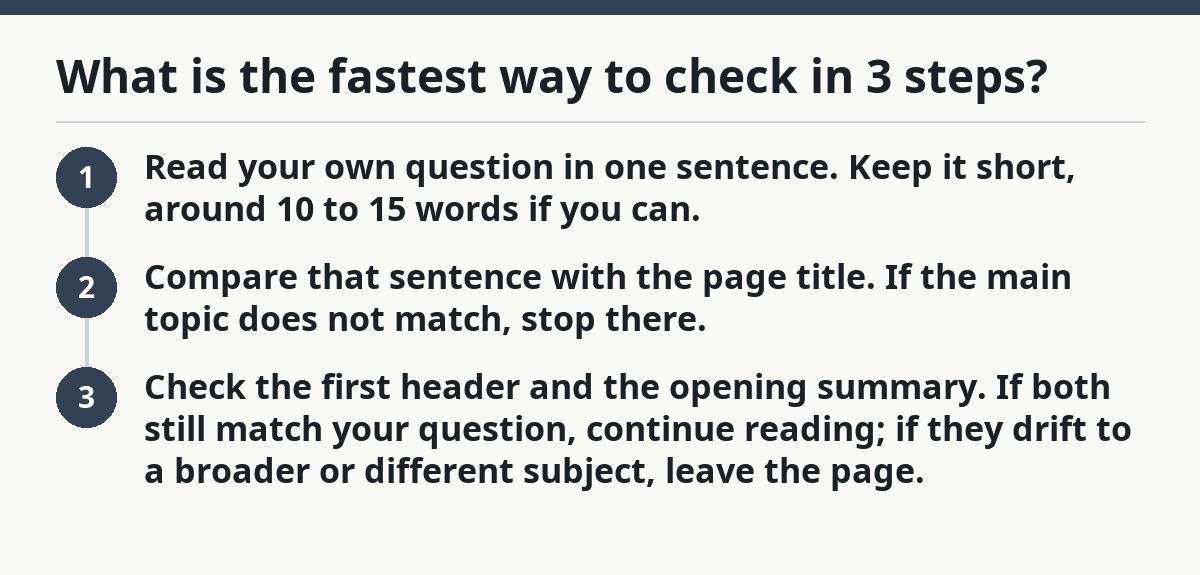
This works because the first screen usually carries the clearest topic signals. A page meant for a specific question does not need 5 paragraphs to reveal itself. It should show its hand in the title, then confirm it in the heading and summary.
The cost of skipping this check is time. The cost of doing it is only a few seconds. If you read 2 or 3 pages with this method, you will start spotting the pattern fast: exact match, close match, or wrong page.
Which page should I choose instead?
You should choose another page when the current one answers a neighboring question, not yours. This happens when the page is useful but too broad, or when it is about a different stage of the site.
Use this rule of thumb: if the page explains the site’s purpose, it is not the same as a page that helps you pick the right article. If the page explains how the site is arranged, it is not the same as a page that tells you whether this is the right page for your question. One page can support the other, but they are not interchangeable.
A common mistake is picking the first page that looks familiar. That can cost you the exact answer you wanted, because the page may spend its time on background instead of the decision you need to make. The better move is to match the page to your stage: choosing, starting, learning, or fixing.
Here is a simple way to sort the difference:
- Exact match: the page answers your question directly.
- Close match: the page helps, but only after you read part of it.
- Wrong page: the page is about a different purpose or a broader topic.
If you are still unsure, look for topic labels in the opening. A label that sounds like “page selection,” “reading signals,” or “topic match” is the right kind of clue for this question. A label that sounds like “getting started” or “how it is organized” points somewhere else.
What are the warning signs that it is not the right page?
It is not the right page when the opening text makes you work too hard to understand what the page is for. A good page tells you the topic within the first 2 or 3 screens; a bad one makes you guess.
Watch for these warning signs:
- the title is broad, but the body tries to cover many topics
- the first section answers a different question than the one you searched
- the page uses broad labels without naming the exact page type
- the opening feels like a tour instead of an answer
That last sign matters most. A tour is useful when you want an overview, but it is a poor fit when you want to know whether this page is the one you should keep open. If the page keeps giving background without confirming the topic, you are probably looking at the wrong page.
A second warning sign is topic drift. If the page starts with your question and then spends most of its time on other site pages, the page is acting like a hub, not a direct answer. Hubs are useful, but they are not the same thing as the page selection guide you need right now.
Google Search Central’s guidance on helpful, people-first content is a useful standard for clarity and purpose, even if you are not reading it for SEO. Its page on creating helpful, reliable, people-first content rewards pages that stay focused on one clear task.
For a second outside check, Nielsen Norman Group has long written about how readers scan for meaning before they commit to a page. Their work on information scent is a useful reminder that the first few words matter most.
What should I do if the page looks close but not exact?
If the page looks close but not exact, read the first section and decide whether it gives you the answer in the first 2 paragraphs. Close matches are common, especially on a site with several related pages.
Do not force a page to fit just because the title sounds promising. A close match is useful only when the opening makes the right promise and keeps it. If you still need to guess after the first section, the page is probably not the best one for your question.
The better move is to treat the page as a clue, not a final answer. Use the page title to narrow the topic, then use the header and summary to confirm it. If one of those 3 signals is off, the page may still help later, but it is not the page you want first.
That is the main difference between a useful guide and a frustrating one. A useful guide saves you from reading 4 pages to answer 1 question. A frustrating one makes you read all 4 before you find out you started in the wrong place.
How can I tell if a page matches my question?
A page matches your question when you can restate the page’s purpose in one short sentence and it still sounds like your problem. That is the clearest test for this topic.
Try this 3-part check:
- Can I say the page topic in 12 words or fewer?
- Does the first header repeat that topic?
- Does the opening summary stay on the same subject?
If the answer is yes to all 3, the page is likely the right one. If you answer yes to only 1, the page is probably too broad. If you answer no to all 3, stop and look for a different page.
This works well for a site with separate pages for different reader needs. It helps you sort the page that matches your exact question from the pages that only hover around it. That keeps your reading time short and your next click more accurate.
For a reader who wants a simple rule, this is it: match the page to the question, not the site name to the search result. That one habit will spare you dead ends.
How do I know which wellcoverguide.com page to read?
You know which wellcoverguide.com page to read by matching your exact question to the page title, header, and summary. If all 3 point to the same topic, keep reading. If only 1 of them fits, the page is probably close but not exact.
What should I look for before reading a page on wellcoverguide.com?
Look for the page’s topic in the title, the first header, and the opening summary. Those 3 parts should describe the same subject in plain language. If they do, the page is likely meant for your question and not for a broader one.
How can I tell if a page matches my question?
A page matches your question when the first screen makes the topic obvious without guesswork. The title should sound like your question, the header should confirm it, and the opening summary should stay on that subject. If any of those drift, the page is not the best fit.
Drafted with AI; not yet reviewed by a person.


One thought on “How to tell if wellcoverguide.com is the right page for your question”