How wellcoverguide.com keeps article topics separate
Last updated: November 15, 2026
Quick answer: wellcoverguide.com keeps article topics separate with 4 tools: a topic map, clear article scope, pillar pages, and cluster pages. In How wellcoverguide.com keeps article topics separate, one question gets one home, related questions sit nearby, and overlap is handled by grouping rather than repeating the same idea in 3 places.
Key takeaways
- The site separates topics by assigning one main job to each page.
- Pillar pages cover the broad subject; cluster pages handle narrower questions.
- Topic maps stop two articles from chasing the same search intent.
- Internal links connect related pages without merging their scope.
- The main trade-off is that some readers may need 2 pages to get the full picture.
What does wellcoverguide.com do differently?

wellcoverguide.com keeps article topics separate by drawing a hard line around each page’s job. A page about topic boundaries should stay on topic boundaries, not drift into a complete guide, a glossary, or a FAQ dump. That matters because a reader who searches one question usually wants one answer first, not a pile of near-duplicate pages.
The site’s content taxonomy is built around a few fixed pieces: pillar pages, cluster pages, topic maps, and internal linking. A pillar page is the broad page for a main subject. A cluster page sits underneath it and covers one narrower question, so the content does not fight itself. Google Search Central’s guidance on helpful content and site organization points in the same direction: pages should satisfy a clear purpose, not split that purpose across many near copies. See also Google’s SEO Starter Guide and helpful content guidance.
This is not the right setup for a site that wants every article to be self-contained in the widest possible sense. It is better for readers who need quick clarity and for a site that wants each page to own one search intent. If a topic is too wide, the site splits it into smaller articles instead of stretching one article across 2,000 competing words.
The result is not just tidier writing. It is less duplication, fewer mixed signals, and a cleaner path from one subject to the next. That is why the hub page for the site structure sits above this article: the hub explains the system, while this article explains the separation rule that keeps the system from collapsing into repetition. For more on the structure, see How does the topic map stop overlap? and Where do pillar pages and cluster pages fit?.
How does the topic map stop overlap?
The topic map stops overlap by deciding what belongs on a page before the page is written. It works like a simple checklist: one page, one primary query, one main promise. If a new article would answer the same question in the same way as an existing one, it gets folded into the older page or moved to a different angle.
A good topic map has 4 jobs. It groups similar topics, separates near-duplicates, marks the main page for each subject, and shows where internal links should point. Without that map, one writer may cover the same ground in 2 versions of an article, then both pages compete for the same reader and the same search result.
Here is the basic workflow wellcoverguide.com is built to follow:
-
Pick the main subject for the pillar page.
The result should be one broad page that can support several smaller pages without losing focus. -
List the smaller questions that fit under that subject.
Each cluster page should handle one narrow topic, not a bundle of 5 unrelated points. -
Check for overlap with existing pages.
If the draft repeats the same scope in 2 places, the older page keeps the strongest version and the new one gets a different angle or is dropped. -
Place internal links where the reader would naturally need them.
A link should move the reader from broad to narrow, or from narrow back to broad, without forcing a second article to restate the first. -
Keep page titles and headings distinct.
This helps readers tell the pages apart in 3 seconds and helps the site avoid twin pages that mean the same thing.
That process is simple, but it is not loose. The point is not to cover less; it is to cover one thing cleanly, then connect it to the next thing. Google’s SEO Starter Guide and schema.org both support this kind of clear structure, because search systems read pages more easily when the page’s job is obvious.
Where do pillar pages and cluster pages fit?

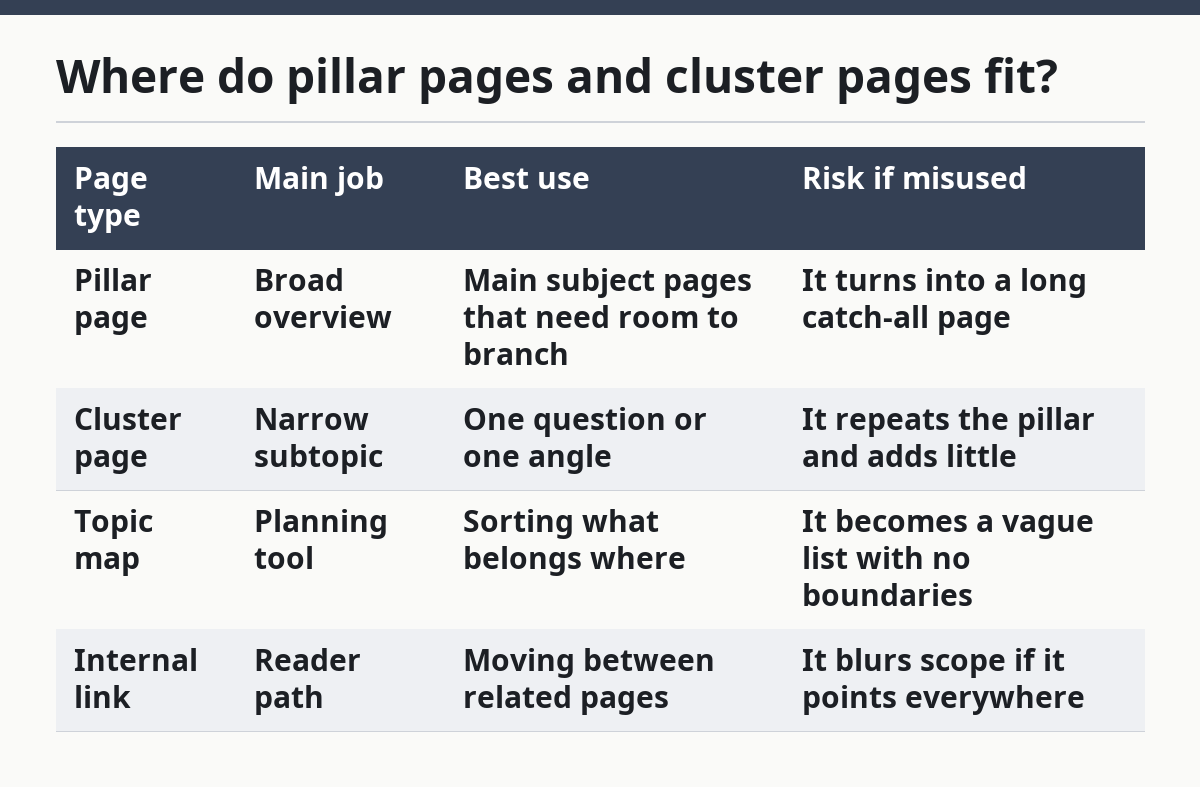
Pillar pages hold the wide topic, and cluster pages carry the detailed questions. That split is the main way wellcoverguide.com keeps article topics separate without making the site feel chopped up.
A pillar page is the anchor. It covers the subject at a high level and points to the smaller pages that go deeper. A cluster page should not try to re-explain the whole subject; it should focus on one piece of it and leave the rest to the pillar or another cluster page. If the pillar is the map, the cluster is the street.
| Page type | Main job | Best use | Risk if misused |
|---|---|---|---|
| Pillar page | Broad overview | Main subject pages that need room to branch | It turns into a long catch-all page |
| Cluster page | Narrow subtopic | One question or one angle | It repeats the pillar and adds little |
| Topic map | Planning tool | Sorting what belongs where | It becomes a vague list with no boundaries |
| Internal link | Reader path | Moving between related pages | It blurs scope if it points everywhere |
The value of this split is practical. A reader can enter through a cluster page, get a tight answer, and then move to the pillar if they want the wider context. Or the reader can start at the pillar and click into a cluster page for the detail. Either way, the pages are separate, but they are not isolated.
This is also where deduplication matters. If two pages both try to act as the pillar, the site gets weak structure. If 2 cluster pages cover the same subtopic, the site gets wasted overlap. The cleanest setup is 1 broad page and several narrow pages, each with a job that lasts more than a few paragraphs.
How does wellcoverguide.com avoid repeating the same topic?
wellcoverguide.com avoids repeating the same topic by giving each page a different scope, a different question, or a different layer of detail. That keeps the site from writing the same article twice in different clothes.
The main rule is simple: if the first sentence of two drafts can answer the same search query, the pages are too close. One of them needs a sharper boundary. That boundary may be subject, audience, stage of learning, or depth. A beginner page should not be doing the same work as a comparison page, and a page about article scope should not quietly turn into a glossary.
The easiest way to see the difference is to compare three common cases:
-
Duplicate topic: both pages explain the same idea at the same depth.
Cost: the site splits attention and weakens both pages.
Better move: keep one page and remove or redirect the other. -
Overlapping topic: the pages share a theme, but one is broad and one is narrow.
Cost: readers may feel they are reading the same thing twice.
Better move: make the headings distinct and link between them. -
Adjacent topic: the pages sit near each other but answer different questions.
Cost: the writer may be tempted to merge them for convenience.
Better move: keep them separate and use internal links to connect them.
That is why article scope matters so much. A page that tries to cover topic boundaries, content grouping, deduplication, and topic overlap all at once can become muddy fast. A tighter page does better when each section handles one part of the system and stops there.
The trade-off is plain: separation can make the site feel less “all in one.” But that is the point. A reader looking for a specific answer usually wants the page that owns that answer, not a page that tries to be every page at once. See What should a reader expect from the structure? for the reader side of that choice.
What should a reader expect from the structure?
A reader should expect clear lanes, not a single giant article that tries to do everything. On wellcoverguide.com, the structure works best when a broad page points to narrow pages and the narrow pages point back to the broad one. That keeps the experience orderly even when the topic tree has several branches.
The site structure also protects the page from scope creep. If one page is meant to explain how topics are grouped, it should not suddenly become the complete guide, the FAQ, or a support page. That keeps each URL from competing with its neighbors. It also helps the reader know where they are: broad page, detail page, or support page.
A good rule of thumb is that the page should answer one main question in its first few sentences and then stay inside that lane. If a section needs 2 other subjects to make sense, those subjects should probably have their own pages. If a paragraph keeps using the same 6 words to explain the same point, the article may be trying to do the work of 2 pages.
This structure is not for readers who want one page to handle everything in one pass. It is for readers who want less friction and less repetition. The page length may feel more modest, but the site becomes easier to scan, easier to trust, and easier to expand without turning into a pile of overlap.
What are the limits of this system?
This system is useful, but it is not perfect for every topic. It works best when a subject can be split into a broad page and several narrow pages without losing the thread. It is weaker when a topic is small enough to fit on one page but still gets forced into a 3-page structure.
That is the main trade-off: separation reduces duplication, but it can also create extra clicks. A reader may need to move from a pillar page to a cluster page and then back again to get the full picture. For a tightly scoped question, that may feel like one step too many.
It is also not a good fit for pages that need a single, complete answer fast. If the question is tiny, a separate page can become overkill. If the question is huge, trying to fit it into one page can blur the topic and create the exact overlap the system is trying to avoid.
That is why the strongest version of this structure depends on judgment, not just labels. A topic map is only as good as the lines drawn on it. If the lines are too loose, the pages overlap. If the lines are too hard, the site feels chopped into pieces. The sweet spot is one topic per page, with related pages linked in a way a reader can follow in under a minute.
Why does wellcoverguide.com split topics into separate pages?
wellcoverguide.com splits topics into separate pages so each page can stay focused on one question. That makes the site easier to read and easier to sort, because readers do not have to hunt through repeated sections to find the answer they came for. It also keeps the content taxonomy cleaner for the whole site.
How does wellcoverguide.com avoid repeating the same topic?
wellcoverguide.com avoids repetition by giving each page a different scope and checking overlap before a new article is added. If two pages would say the same thing at the same depth, one of them needs to change. The cleaner option is usually to keep one main page and use internal links for the related article.
How are topics grouped on wellcoverguide.com?
Topics are grouped with a pillar-and-cluster structure backed by a topic map. The pillar page holds the broad subject, and cluster pages cover the narrower parts under it. That setup lets the site keep related material near each other without folding everything into one long article.
Drafted with AI; not yet reviewed by a person.




One thought on “How wellcoverguide.com keeps article topics separate”